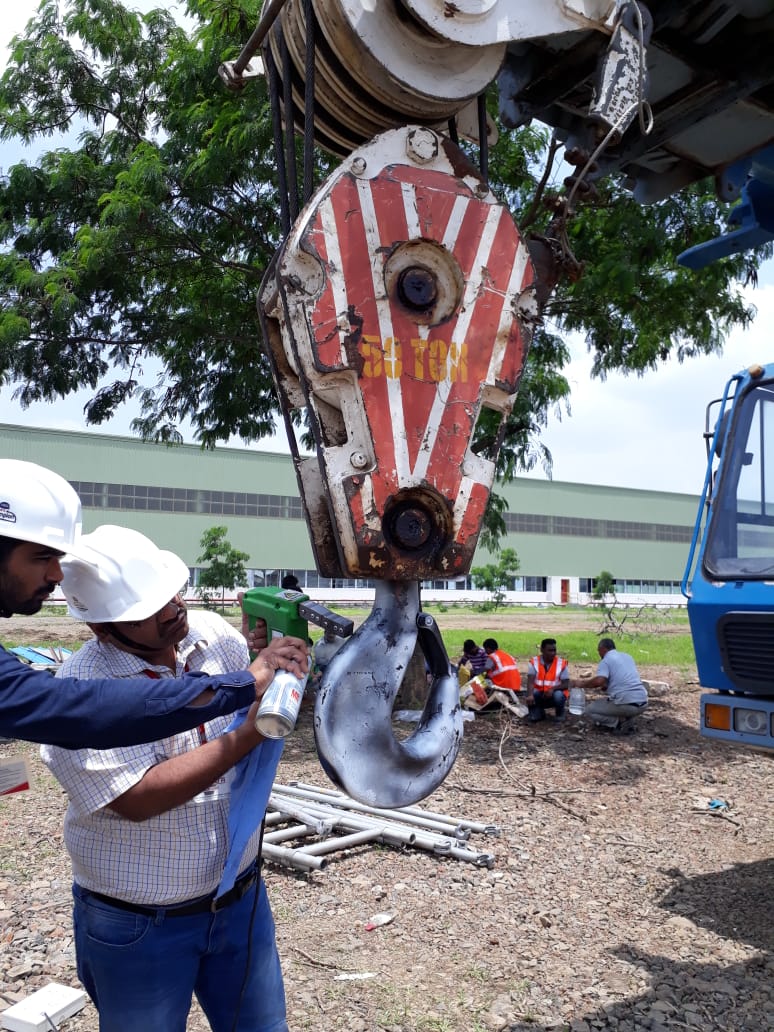
Preparation of part for Penetration Test

Prior to the test, the area to be inspected and at least one inch on either side shall be free from all contaminants (dirt, grease, lint, slag, spatter, oil, scale, water and protective coatings).

It is recommended by the manufacturer, welded components or parts cleaned by Vapour degreasing, organic solvents or detergents, and properly protected from contamination, need not be re-cleaned with penetrant cleaner (remover) prior to application of the penetrant.

A wire brush may be helpful in removing rust, surface scale, but it is used only  when no other means of removal will surface.

Light Intensity Requirement

Color Contrast Penetrants: Illumination (natural or supplemental white light) of the examination surface is required for the evaluation of indications. The minimum
light intensity shall be 100 fc (1 000 lx).

Fluorescent Penetrants: Black lights shall achieve a minimum of 1000 μW/cm2 on the surface of the part being examined throughout the examination.

Capillary Action

  • Liquid rises through the cavity of a fine bore tube against the gravity. This is known as capillary action.
  • The finer the bore, the more is the capillary force.
  • Liquid enters narrow discontinuities because of capillary forces.
  • A plant takes in water through capillary action.


Image result for capillary action

Types of Indication in Liquid Penetration Testing

Indication:
marks a discontinuity. In LPT it is the presence of bleed out.

Nonrelevant Indications:
LPI indications resulting from conditions not associated with a material discontinuity.

Irrelevant Indication:
indication resulting from poor technique and not associated with a material discontinuity.

False indication: Indication created by improper cleaning of the test surface by any dirt, paint, oil, grease or any loose scale that could either keep penetrantout of a defect, or cause irrelevant or false indications.

Evaluation of Indication

Dye penetrant test evaluation should be reviewed in conjunction with liquid penetrant acceptance criteria.

The evaluation should be done by the qualified technician Level II or Level III and based on project approved test procedure. The technician should be familiar with product expected defects and discontinuities.

The technician should have experience and knowledge to differentiate  between relevant indication and false indication. The false indication is caused by the poor washing of penetrant material in the washable water system.

What is the relevant Indication? The relevant indication represents the real discontinuities. As per ASME VIII Div 1 Appendix 8, a relevant indication is an indication that its major size is greater than 1.5 mm . The technician normally ignores any indication that is smaller than 1.5 mm

If the dye penetration testing technique is visible, then min light requirement is 1000 Lux or 100 ft candle. If the technique is fluorescent technique, then ultraviolet light intensity should not be less than 1000 microW/cm2