Magnetic Particle Test Process

1. A suitable technique of magnetization is chosen.
2. The part is magnetized in the desired direction.
3.  While the magnetizing field is present, iron powders
are applied dry or wet.
4.  Iron powders bridge the leakage fields, if present, to produce
indications.
5.  Powder patterns produced by flaws are identified and
accept reject decision is made.

MPT Process.jpg

Ferromagnetic Materials

  • A material is considered ferromagnetic if it can be magnetized. Materials with a significant Iron, nickel or cobalt content are generally ferromagnetic.
  • Ferromagnetic materials are made up of many regions in which the magnetic fields of atoms are aligned. These regions are call magnetic domains.
  • Magnetic domains point randomly in demagnetized material, but can be aligned using electrical current or an external magnetic field to magnetize the material.

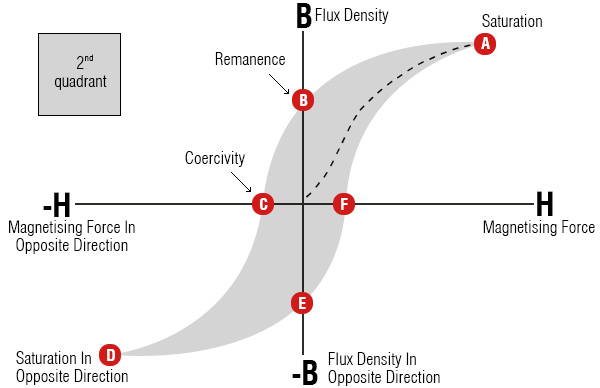
MAGNETIC PROPERTIES

TechCentre_Hysteresis-Loop-Diagram

What is magnetic flux?

Magnetic flux is a measurement of the total magnetic field which passes through a given area. It is a useful tool for helping describe the effects of the magnetic force on something occupying a given area.

Retentivity ?

we have an electromagnetic coil with a high field strength due to the current flowing through it, and that the ferromagnetic core material has reached its saturation point, maximum flux density. If we now open a switch and remove the magnetising current flowing through the coil we would expect the magnetic field around the coil to disappear as the magnetic flux reduced to zero.

However, the magnetic flux does not completely disappear as the electromagnetic core material still retains some of its magnetism even when the current has stopped flowing in the coil. This ability for a coil to retain some of its magnetism within the core after the magnetisation process has stopped is called Retentivity

Advantages & Limitation of MPT

Advantages Of MPT:

1.Detects flaw below ¼” below surface.

  1. Detects flaw filled with foreign material.
  2. Detect defect below painted & platted surface.
  3. Immediate indication.
  4. Testing is possible up 300°C using dry powder.
  5. Indication can recorded.

Limitation of MPT :

1.Applicable to only ferromagnetic material only.

2.Limited depth of detection.

3.Depth & size is not indicated.

4.Sensitivity varies with surface roughness & position.

5.Sensitivity rapidly diminishes with depth.

Detection of leakage field :

Detection of leakage field :
Finely divided iron particles are used for detection of leakage field. Leakage  field at the surface collects and hold the iron particles together to form visible indication patterns.

  • Flaws at or near the surface disturb the magnetic flux flow and produce leakage field at surface above the flaw.
  • Magnetic particle build up at the leakage field produces recognizable patterns which are interpreted.
  • Color of the particles must be chosen to provide adequate contrast against the part’s natural color.

Discontinuities at or near the surface produce magnetic leakage field on the surface

Discontinuities at or near the surface produce magnetic leakage field on the surface :
Magnetic flux in a magnetized part pass through the body of the part. Discontinuities at or near the surface of the part disturb the normal flow of magnetic flux and leakage flux fields are produced on the surface above the discontinuities. These leakage fields attract  iron particles and are detected by applying iron powders.

Magnetic Particle Testing

  • When a ferromagnetic material is magnetised the flux lines flow inside the component

  • When there is a discontinuity in the material there is flux leakage

  • The leaking flux attracts a magnetic medium resulting in an indication.

What is magnetic particle testing?

What is magnetic particle testing?

This method is used for the detection of surface and near-surface flaws in ferromagnetic materials and is primarily used for crack detection. The specimen is magnetised either locally or overall, and if the material is sound the magnetic flux is predominantly inside the material. If, however, there is a surface-breaking flaw, the magnetic field is distorted, causing local magnetic flux leakage around the flaw. This leakage flux is displayed by covering the surface with very fine iron particles applied either dry or suspended in a liquid. The particles accumulate at the regions of flux leakage, producing a build-up which can be seen visually even when the crack opening is very narrow. Thus, a crack is indicated as a line of iron powder particles on the surface.